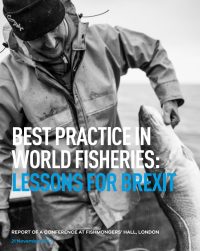
International fisheries agreements which set catch limits for shared stocks are complicated, require cross-boundary liaison and should not be left to the last minute during any major political transition such as Brexit. Industry should take a lead in these negotiations to ensure a pragmatic solution is reached.
In the United States, Australia, New Zealand and Norway, national or federal government controls offshore fisheries. In the United States, management is devolved but with strong accountability to federal government. There are other good examples of regional government co-operation over inshore fisheries but, as the main Australian speaker pointed out, it was more effective for a single authority to manage key stocks than for multiple authorities to do so. He went so far as to suggest that Scotland could manage the UK’s cod.
A science-based approach was advocated by all four countries, but different methods of assessing maximum sustainable yield were adopted, with the United States, New Zealand and Norway using deliberately conservative methodologies. All the main speakers and panellists favoured allocation controls rather than effort controls because of the difficulty of obtaining good data from effort control mechanisms.
The cost of good management should not be underestimated: in New Zealand and Australia industry pays for the science; in the United States it was largely the federal government, with industry now carrying some costs. Trust is enhanced if fishers work closely with scientists. Inshore fisheries tend to have less reliable data.
There are contrasting approaches to ownership rights. In Norway, fish resources are owned by the people, not the government. New Zealand quota can be owned privately in perpetuity and only New Zealand citizens may own quota. In Australia, the commercial licence fee is the price exacted by the public for the appropriation of a limited public natural resource. The United States has a variety of rights-based approaches across all sectors, including small scale fisheries.
All four countries have examples of enforcement that differ from current United Kingdom practice, whether in terms of high levels of observer coverage, remote monitoring, or reporting catches. In New Zealand, penalties for serious breaches of regulations involve the confiscation of equipment and the right to fish. Norway said the European Union’s discard ban was too inflexible.
In all four countries, marine conservation was more integrated into the fisheries management system than in the United Kingdom or the European Union. Australia compensated fishers for loss of access following the designation of marine protected areas. Some 30 per cent of the New Zealand exclusive economic zone is closed to fishing, to protect seafloor habitat.
Experts from all four countries said it was desirable that recreational angling should be more involved in fisheries management. Successive speakers emphasised that choices needed to be made about the kind of industry and recreational sector a country wants. There is a value in stakeholders agreeing a response to varying conditions, including climate change, before they become disruptive.