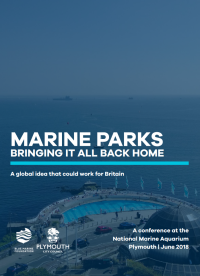
In June 2018, Blue Marine Foundation and Plymouth City Council organised a conference at the National Marine Aquarium to explore the idea of Marine Parks. The proposition discussed was that Marine Parks could improve the conservation of the natural beauty, wildlife and cultural heritage of the UK’s coastal waters and create more opportunities for the understanding and enjoyment of the special qualities of outstanding marine areas by the public. The 130 delegates heard first-hand experience and perspectives from around the world and from the length and breadth of the UK coast. A consensus was then reached: Marine Parks could be used to better protect coastal waters as public assets while bringing shared prosperity, broader public engagement and regeneration of deprived coastal communities.
So what is a marine park? A marine park, as envisaged by the conference, is a multi-use space – an umbrella designation that draws together pre-existing, valuable designations such as marine conservation zones, alongside commercial and recreational uses of the marine space. The Marine Parks designation uses the power of narrative and better public understanding to derive wider benefits from a fragmented marine landscape: with the whole being more valuable than the sum of its existing parts. However, there cannot be a one-size-fits-all approach to marine parks. This is a designation that should be considered on a case-by-case basis, and driven by the needs of local communities, reflecting community priorities and delivering locally-appropriate social, economic and environmental benefits.
There is much to be gained from branding and celebrating the diversity of our marine and coastal ecosystems. The conference heard from several speakers that Plymouth Sound and its nearby waters are an ideal testbed for a marine park. It was agreed that by connecting and weaving together pre-existing designations and uses, a National Marine Park in Plymouth Sound could improve the delivery of a range of public interest and conservation objectives. Global experience suggests that public interest and cross-party support is essential for the creation of marine parks. Plymouth would appear to fulfil these conditions: there is an interested, Labour-controlled council, led by Tudor Evans, OBE, and cross-party political support for exploring the idea of a marine park in Plymouth Sound from both Luke Pollard, the Labour MP for Plymouth Sutton and Devonport, and from Michael Gove, the Conservative Environment Secretary. There is a high-conservation-value environment, maritime heritage, varied marine stakeholders and a diverse city of over 250,000 people. Plymouth has an opportunity to become the example that others follow.