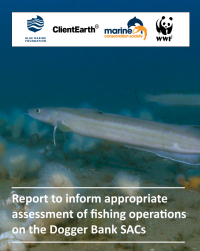
The UK, the Netherlands and Germany have designated 18,765 km2 of the Dogger Bank as a marine protected area under the Habitats Directive to safeguard its subtidal sandbanks. Denmark has yet to designate its portion. The Dogger Bank was an important fishery in the 17th and 18th centuries: the probable cause of the decline of fish stocks is bottom trawling which has reduced the number of long-lived or fragile organisms. It is home to the common skate and angel shark (both listed as critically endangered by IUCN) and the Atlantic halibut (IUCN listed as endangered). The Dogger Bank also had a large population of native oysters. Common skate is still caught in small numbers as by-catch; it is thought the other rare species may be present in small numbers too. Trawling activity has resulted in a community dominated by robust short-lived invertebrates, rather than the species for which the Bank was once famous. The impact of bottom trawling is the principal reason for the Dogger Bank’s conservation status being listed as unfavourable. Under the powerful EU Habitats Directive, legal protection for the Bank should have begun in 2007 (Germany), 2009 (the Netherlands) and 2012 (UK). Even after nearly 10 years there are no management measures for fishing activities –the Dogger Bank is a “paper park.” Article 11 of the Basic Regulation of the Common Fisheries Policy provides an avenue for Member States and the UK to make recommendations for management measures, which can then be enacted through the Common Fisheries Policy. To date, no legally compliant proposals have been presented to the Commission by the Member States or the UK. The Article 11 process does not remove the obligation for the UK and all Member States fishing the Dogger Bank to introduce management measures relating to their own vessels. Under Article 6 of the Habitats Directive, Member States and the UK need to halt the deterioration of the Dogger Bank and that fishing activities can only be permitted if they will not adversely affect its integrity. To date, despite the time that has elapsed, no proper impact assessment has been undertaken to investigate the impact of fishing activities in the Dogger Bank. This report carries out a scientific assessment and concludes that bottom impacting fishing gears cause harm and should be halted as soon as possible. For pelagic fisheries and traps and pots it may be possible to permit fishing if these can be confidently monitored and the impacts of the fishery known. Proper measures need to be brought in by the Member States and the European Commission and the UK as a matter of urgency.

Impact Report 2025
Blue Marine drives global ocean recovery by advancing marine protection, restoring habitats, influencing policy, supporting communities and tackling overfishing, with measurable impact across 29 countries and 446,620 sq km of ocean.
27 February 2026