Project

Global

A just transition for UK fishing

To achieve the equitable and sustainable use of marine resources, dredging and trawling must be stopped within our MPAs. We believe this should be done in a way that brings industry and sea users along in the process. 

Sustainable fisheries

The challenge

Bottom-towed fishing is one of the most destructive forms of fishing. Gear such as dredges and trawls directly impact the seafloor, destroying habitats and ecosystems. Blue Marine is campaigning to ban bottom-trawling in all marine protected areas (MPAs) and advocating for transition to lower-impact activities.    

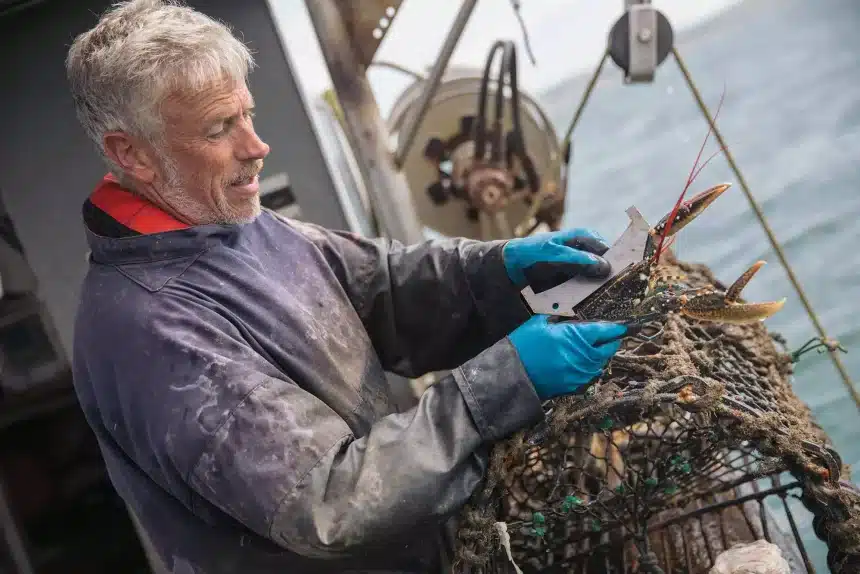
Transitioning away from destructive fishing practices has significant environmental benefits. A just transition requires early engagement with the fishing and seafood supply chain. It should consider alternative fishing activities or emerging sectors, while avoiding unintended consequences for other fisheries and sea users, or for the environment.   

To ensure that one problem (damage of seabed habitat) is not exchanged for another (competition and conflict with low-impact small-scale fishing communities on inshore grounds), Blue Marine supports the principles of a just transition, while ensuring that a move to lower-impact practices does not unjustly affect existing small-scale fishing communities. 
 

Our strategy

The concept of ‘just transition’ arose from the US trade union movement in the 1980s, and has gained traction in economic and policy circles. It describes the effort to plan for and invest in a transition to environmentally and socially sustainable jobs, sectors and economies, while ensuring that the whole of society – communities, workers and social groups – is brought along in the process.  

To better understand a just transition approach to UK fisheries and marine spatial management, Blue Marine developed a Just Transition Analysis Framework to assess social, economic and environmental impacts, and tested its application in a number of hypothetical scenarios.  

The framework was presented at the World Fisheries Congress in 2024 and will be used to inform government policy on equitable use of our marine resources alongside environmental protection. We are also working to apply just transition in other UK fisheries policy, including quota allocation, subsidies and fisheries management plans. 


Remove

Stay connected

We respect your privacy. By subscribing to our email list, you agree to our Terms & Conditions.

This field is for validation purposes and should be left unchanged.

Stay connected

We respect your privacy. By subscribing to our email list, you agree to our Terms & Conditions.

This field is for validation purposes and should be left unchanged.